Current Conditions: All service areas are currently clear of snow and freezing temperatures.
Heavy-Duty Plow Trucks
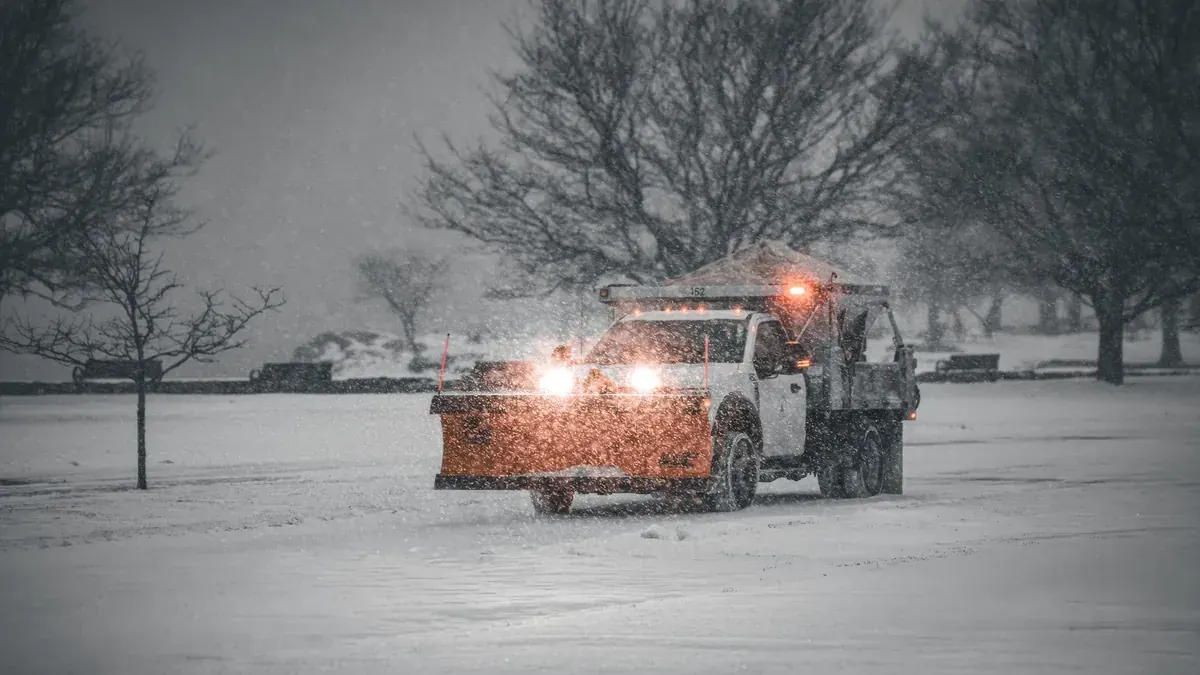
The plow trucks that run our routes all winter: heavy-duty chassis, V-plows, and bed spreaders clearing Cleveland and Akron around the clock.
Plow Trucks: The Backbone of Every Winter Route
Everything else in a snow fleet is a specialist; plow trucks are the army. They run the residential routes at 3 a.m., open the commercial lots before the first employee, cut the city berms at driveway aprons, and connect every property on a route into one continuous night of work. Our plow trucks are the machines most clients actually see, and they’re built for the winters Cleveland and Akron actually get.
Heavy-duty is a spec, not a slogan. These are three-quarter and one-ton commercial chassis with upgraded alternators, transmission coolers, and plow-prep packages, because plow trucks live a harder life than any pickup on the road. A half-ton with a garden-center blade can push a dusting; lake-effect asks more of the iron, every week, for four months.

The blades do the talking. Our plow trucks run V-plows where the routes demand versatility: the V-position punches through deep drifts and windrows, the scoop position carries snow to the pile instead of smearing it sideways, and straight mode handles the wide-open passes. Wings and containment edges go on where lots need cleaner one-pass work.

Most of our plow trucks carry bed-mounted spreaders, which turns two visits into one: the lot gets scraped and salted in a single pass, with ground-speed controls metering the material evenly. For clients, that combination is why the pavement is black by morning instead of white-packed with a stripe of salt down the middle.

Route discipline is what separates a fleet from a collection of trucks. Each of our plow trucks runs an assigned route all season with the same operator, who learns every apron, mailbox, and low-hanging branch on it. Dispatch tracks every truck by GPS, storms trigger automatically off National Weather Service monitoring, and the route order is built backward from client deadlines: commuters first, opening times honored, 24-hour sites cycled continuously.
How Our Plow Trucks Run a Storm
- Pre-storm staging: Trucks fueled, blades mounted, spreaders loaded before the first flake, positioned by forecast.
- Trigger dispatch: Routes launch automatically at each client’s trigger depth, no phone calls required.
- Deadline-first sequence: The route order follows client deadlines, not driving convenience.
- Scrape-and-salt passes: One-pass clearing with spreader work where contracted, walkway crews following behind.
- Return cycles: Long storms get repeat passes, with the GPS log recording every visit for every client.
Between storms the trucks go to the shop, not the back lot: cutting edges rotated, hydraulics checked, spreader chains serviced. Plow trucks break in use or in the bay, and February only forgives the second one.
What Plow Trucks Handle Best
- Residential routes: Driveways, aprons, and city berms at route density and commute speed. See Residential Snow Removal.
- Commercial lots: Small and mid-size lots scraped and salted in single passes before opening. See Commercial Snow Removal.
- Connective work: The drives, lanes, and approaches between the big-site zones the loaders own.
- Storm response: Fast, flexible dispatch when bands shift and routes need real-time reshuffling.
When pavement outgrows what plow trucks do efficiently, the front-end loaders and box plows take over, and the full lineup lives on the Equipment Fleet page.
Plow Truck Questions
Why do heavy-duty plow trucks matter for my property?
Because winter doesn’t scale down for light equipment. Heavy-duty plow trucks push deep, wet lake-effect without overheating transmissions or folding blades, which means your route finishes on schedule in exactly the storms where lighter rigs start failing.
What’s the advantage of a V-plow?
Three blades in one: V-position to punch drifts, scoop to carry snow to the pile, straight for open passes. On mixed routes, V-plows let one truck do work that would otherwise take two, and your driveway apron gets a cleaner cut because of it.
Do the same trucks salt as well as plow?
Most of our plow trucks carry bed-mounted spreaders with ground-speed controls, so lots get scraped and salted in one pass at measured rates. The details of the material side live on the Salting & Ice Control page.
Will the same driver plow my property all winter?
Yes, by design. Each truck runs an assigned route all season with the same operator, who learns every edge, apron, and obstacle on it. Familiarity is the cheapest damage prevention there is.
How do you keep trucks from breaking down mid-storm?
Shop discipline between storms: edges rotated, hydraulics inspected, spreaders serviced, and staged backups for the parts that fail at 3 a.m. When a truck does go down mid-event, a spare rolls and the route continues while the shop works.
Are plow trucks enough for a big industrial lot?
Up to a point, and we’ll tell you honestly where that point is. Acreage jobs go faster and cheaper with loaders and box plows; plow trucks handle the connective pavement and the finish work around them. The right mix is part of every commercial quote.
How do I know the truck actually came?
GPS. Every truck is tracked, every visit is logged with times and services, and clients can verify the record any time. It’s the same documentation that defends slip claims for our commercial accounts.
What does plow truck service cost?
It’s priced by the property, not the machine: driveway size or lot acreage, walkway footage, and trigger depth. Seasonal plans fix one number for unlimited visits; the Pricing Guide shows the structures.
How much does a truck snow plow cost?
A commercial-grade plow setup commonly runs several thousand dollars installed, with V-plows and larger blades pushing well past that, before the spreader, the strobes, and the heavier front suspension the truck needs to carry it all. Add insurance and maintenance and the homeowner math rarely works: for the cost of equipping one truck, most households could buy years of professional service that shows up while they sleep.
Can you plow snow with a half-ton pickup?
Light-duty trucks can carry small personal plows for their own driveways, but commercial route work exceeds what half-ton front axles, transmissions, and cooling systems are built to survive: deep wet snow overloads them, and repeated plowing shortens their lives dramatically. That’s why professional fleets run three-quarter and one-ton chassis with plow-prep equipment. The truck matters less on the easy nights and entirely on the hard ones.
How fast do trucks drive while plowing?
Slower than people think: lot and driveway work runs at walking-to-jogging pace, roughly 5 to 10 mph, because control and placement beat speed, and transport between sites follows normal traffic law with the blade angled. Higher speeds throw snow farther but punish equipment, pavement, and anything the operator didn’t see. The productive kind of fast is route density and technique, not throttle.
What is back dragging?
Back dragging is pulling snow backward, dropping the blade close to a garage door, building, or dock, then reversing to draw the snow out into the open where it can be pushed normally. It’s the technique that cleans the five feet a forward pass can’t touch without hitting the structure. Watch a residential route and you’ll see it at every garage apron; done well, it leaves the door line as clean as the open driveway.
What are cutting edges and how often do they wear out?
The cutting edge is the replaceable steel or urethane strip along the blade’s bottom that actually contacts pavement, sacrificing itself so the plow’s structure doesn’t. Steel edges suit heavy scraping; urethane runs quieter and gentler on decorative surfaces. Wear depends entirely on hours and pavement abrasiveness, and a busy lake-effect season can consume multiple sets per truck, which is why edge inspection is part of our between-storm shop routine.
Why do plow trucks carry ballast in the bed?
A plow hangs several hundred pounds ahead of the front axle, lightening the rear wheels that provide traction, so ballast, salt load, or dedicated weight behind the rear axle, rebalances the truck. The elegant version is the bed spreader: the salt is the ballast, and the truck gets lighter in step with the material it spreads. An unballasted plow truck spins where a balanced one pushes, which drivers learn exactly once.
What lights do plow trucks run?
Amber warning beacons or LED strobes for visibility, required or expected in most jurisdictions for plow operation, plus auxiliary plow lights mounted above the blade because the raised plow blocks the truck’s factory headlamps. Blade guide sticks on the plow’s corners tell the operator where the steel ends in a whiteout. The light package isn’t decoration; it’s how a 9-foot blade works around parked cars at 4 a.m. without incident.
What is a plow-prep package?
A factory option on heavy-duty trucks that fits them for plow duty from the assembly line: higher-output alternator for the hydraulics and lights, stiffer front springs for the blade’s weight, upgraded cooling, and wiring provisions for the plow harness. Trucks ordered with plow prep carry blades within their engineering limits; trucks without it improvise, and improvisation is what breaks at 3 a.m. Our fleet orders the package on every chassis.
How many driveways can one truck clear in an hour?
On a dense route with standard two-car driveways and a practiced operator, roughly six to ten per hour including aprons, with the number falling as snow deepens and driveways lengthen. That density math is why route-based service costs a fraction of on-demand calls: the truck’s travel time is spread across neighbors instead of billed to one address. It’s also why signing up alongside neighbors gets everyone a better rate.
What do plow trucks do in the summer?
The blades come off, the spreaders get washed, serviced, and stored, and the trucks work the rest of the year in hauling and property service roles, which keeps drivers employed and equipment exercised instead of rusting in a yard. Fall is the fleet’s training camp: mounts inspected, hydraulics cycled, new routes driven in daylight. A November-ready fleet is built in September, never in the first storm’s headlights.