Current Conditions: All service areas are currently clear of snow and freezing temperatures.
Box Plows (Snow Pushers)
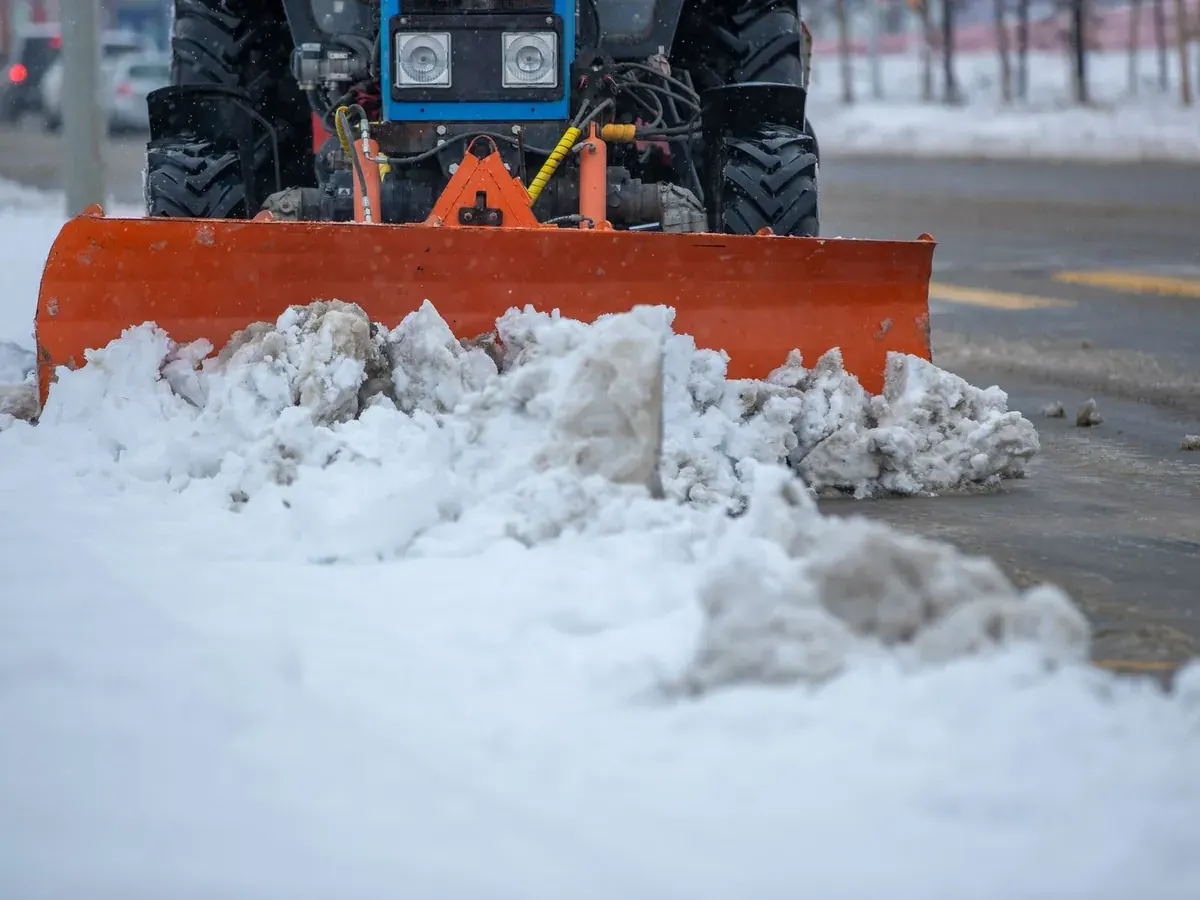
The box plows that turn acres into hours: 10 to 16-foot pushers that carry snow to the stack instead of casting it into next week’s problem.
Box Plows: Why the Big Lots Get Cleared in Hours, Not Days
A straight blade casts snow sideways, which works until the pavement gets big. On a forty-acre lot, casting means re-handling the same snow pass after pass, building windrows that have to be moved again, and finishing sometime around lunch. Box plows solve the geometry: three-sided pushers that capture a full lane-width of snow and carry it, all of it, straight to the stacking corner in one trip.
The math is why every serious commercial fleet runs them. Our 16-foot box plows move roughly four times what a pickup blade handles per pass, with nothing spilling out the sides to re-plow. Multiply that across a truck court or a retail lot and box plows are the difference between a property that opens on time and a contractor still pushing at noon.

Carrying beats casting for a second reason: pile discipline. Because box plows deliver snow exactly where the operator aims them, the stacks land in the corners the site plan chose, not wherever the windrow petered out. Sightlines stay open, prime parking stays parking, and drainage paths stay clear, which is most of what separates managed pavement from plowed pavement.

Ours mount on the machines built to push them. The 14 and 16-foot box plows ride on front-end loaders for truck courts, intermodal yards, and the region’s biggest retail pavement. Compact 8 and 10-foot pushers go on skid steers for tight lots, dock aprons, and drive lanes. Same physics, sized to the space.

Edge choice protects the pavement under the push. Steel trip edges handle worn asphalt, rubber and polyurethane edges go on decorative surfaces, fresh sealcoat, and parking decks, and the pre-season walk decides which edge works which property. Box plows run properly leave black pavement and intact joints; run carelessly they’re a gouging machine, which is why ours ride with operators who work the same sites all winter.

Where the Box Plows Earn Their Keep
- Truck courts and DCs: Lane-widths per pass so carriers stay on appointment. See Warehouse Snow Removal.
- Intermodal and freight yards: Dozens of acres opened in hours on staged equipment. See Intermodal Snow Removal.
- Retail and campus lots: Full-capacity clearing with piles exactly where the plan says.
- Storm digouts: Deep-snow emergencies where casting blades just make taller problems.
- Pre-stack for haul-off: Snow consolidated into loader-ready piles when it’s time to leave the property.
Dispatch runs like the rest of the fleet: automatic triggers off National Weather Service monitoring, big-site staging from December through March, and GPS logs on every pass.
Why Big Properties Ask About the Pushers
- Four-Times Throughput: A 16-foot pusher moves what four pickup passes would, with no spill to re-handle.
- Pile Precision: Snow lands in the planned corners, protecting sightlines and stalls.
- Sized Range: 8 to 16 feet, matched to loaders and skid steers per property.
- Surface-Safe Edges: Steel, rubber, or poly, chosen at the pre-season walk.
The machines that carry them live on the Equipment Fleet page, and the service programs they power run through Commercial Snow Removal and Parking Lot Snow Removal.
Box Plow Questions
What’s the difference between box plows and regular plows?
Geometry. A straight blade casts snow sideways and leaves windrows to re-handle; box plows capture snow between side plates and carry the whole load to the stack in one trip. On big pavement that’s a fourfold throughput difference, which is why the acreage jobs all run pushers.
Does my lot need box plow service?
If the pavement runs past a couple of acres, probably. Below that, plow trucks handle it more economically, and we’ll say so in the quote. The right machine mix is chosen per property, not upsold per invoice.
How much snow can a 16-foot pusher move?
A full lane-width of deep snow per pass, roughly four pickup blades’ worth, with nothing escaping the side plates. It’s the difference between a truck court open for the morning appointments and one still being pushed at noon.
Will box plows damage our pavement or joints?
Not with the right edge and operator. Steel trip edges for worn asphalt, rubber and poly for decks and decorative surfaces, all decided at the pre-season walk, all run by operators who work the same site all winter. The gouging stories come from rental units and rookies.
Where does the snow end up?
Exactly where the site plan says, which is the quiet superpower of a pusher. Piles land in agreed corners away from sightlines, drains, and prime stalls, and when the corners fill, the same stacks are loader-ready for haul-off.
Do you stage box plows at big properties?
Yes. Large commercial accounts get loaders and box plows positioned on site December through March, so lake-effect response starts in minutes. Intermodal yards, DCs, and major retail properties use staging most.
Can box plows work tight lots too?
In compact sizes, yes. The 8 and 10-foot pushers mount on skid steers for dock aprons, drive lanes, and urban lots where the full-size units won’t turn. Same carrying physics, scaled to the walls.
How is box plow service priced?
As part of the property’s plan: acreage, layout, and deadlines set the number, and the machine list follows. Right-sized pushers lower the cost per cleared acre, which usually makes the quote better. The Pricing Guide shows the structures.
What sizes do snow pushers come in?
The industry range runs from 6-foot compact units for small skid steers up to 30-foot monsters on the biggest loaders at airports and mega-sites, with 8 to 16 feet covering nearly all commercial property work. The sizing rule is the host machine’s weight and horsepower plus the site’s tightest geometry: the widest pusher the property’s corners allow, on the biggest machine the pavement justifies, clears the most acres per hour.
What is a trip edge on a box plow?
A trip edge is a spring-loaded bottom section that folds back when the pusher strikes a hidden obstacle, a raised manhole, a frozen chunk, a curb lip, absorbing the hit instead of transferring it to the machine, the pavement, or the operator’s spine. It resets instantly and keeps pushing. On properties with rough or unfamiliar pavement, trip protection is the difference between an incident report and a sound nobody mentions again.
What is a sectional snow pusher?
A sectional pusher divides its cutting edge into independent spring-loaded segments, each following the pavement’s contours separately, so the whole edge stays in contact across crowned, rutted, or settled surfaces where a rigid edge would bridge the low spots and leave strips of snow. Sectionals scrape closer to bare pavement on imperfect lots, which most lots are. They cost more and earn it back in scrape quality and reduced salt demand.
Why don’t box plows work for driveways?
Scale mismatch: even a compact 8-foot pusher on a skid steer needs maneuvering room a residential driveway doesn’t offer, and the machine’s travel time between houses erases any clearing speed advantage. Driveways belong to plow trucks running dense routes, which is exactly how our residential service works. Pushers exist for the properties where pavement is measured in acres and deadlines in truck appointments.
How much does a snow pusher attachment cost?
Commercial pushers commonly run from a few thousand dollars for compact skid steer units to well past ten thousand for large loader-class and sectional models, before the six-figure machine that carries them. That stack of capital is the practical answer to why properties contract this capability: the service contract buys the pusher, the loader, the operator, and the 3 a.m. dispatch as one line item that only exists in winter.
Do box plows scrape down to bare pavement?
Good ones, run well, come close: edge contact and machine down-force determine the scrape, with sectional edges getting nearest to bare on imperfect surfaces, and a thin film after mechanical clearing is what ice control chemicals are for. A pusher riding too high leaves pack that traffic polishes into ice, which is an operator problem, not an equipment problem. The scrape quality on the first storm tells you which one you hired.
What machines can run a box plow?
Anything with the hydraulics and weight: wheel loaders and skid steers are the classic pairings, with backhoes, compact track loaders, telehandlers, and agricultural tractors all pushing appropriately sized boxes in various fleets. The machine’s weight and traction set the practical limit, since an underweight machine spins before the box fills. Our fleet standardizes on loader and skid steer pairings because they cover every property size we serve.
How do you move a 16-foot pusher between properties?
Carefully and rarely: a 16-foot box exceeds legal road width for casual travel, so big pushers move on trailers or stay put, which is the logistical argument for on-site staging at large accounts. The pusher winters where it works, mounted and ready, and the storm response never waits on a trailer move. Compact skid steer units travel easily, which is why they cover the multi-site urban routes.
Do box plows reduce how much salt a lot needs?
Meaningfully, yes: the cleaner the mechanical scrape, the less snowpack remains for chemicals to burn through, and a well-run pusher leaves so little behind that ice control becomes a finishing layer instead of the main event. Properties that switch from casting blades to carried pushing routinely see material usage drop, which pays twice: lower salt costs and less chloride load on the pavement, the landscaping, and the watershed.
Can a box plow pull snow away from buildings?
With a pull-back kit, yes: some pushers add a rear-facing edge that lets the operator drop the box close to a wall or dock face, drag the snow backward into open pavement, then turn and push it away, the pusher’s version of a truck’s back-dragging. It’s the technique that cleans dock faces and building lines without a second machine. Where geometry is tighter still, the skid steers finish what the big boxes can’t reach.